




Whether you're shopping for a basic multi or a complete organic vitamin plan, most of us approach supplement shopping the same way. You look for the nutrients you want, check the milligrams, glance at the percent daily value, and make a choice. The problem is that those numbers are only telling you what’s in the capsule……………but they’re not telling you something far more important.
Bioavailability Is the Number You Won’t Find On The Label
The vitamin dosage that actually enters your bloodstream through your digestive tract and becomes "available" to your biological systems is referred to as bioavailability and it is affected by many different factors. A few external drivers are your general gut health and the foods you eat in addition when taking those supplements. However, many people are unaware of how crucial the chemical form of vitamin supplement itself can be in how much impact it has on your health. The good news is that you get to make that decision as long as you know what you’re looking for.
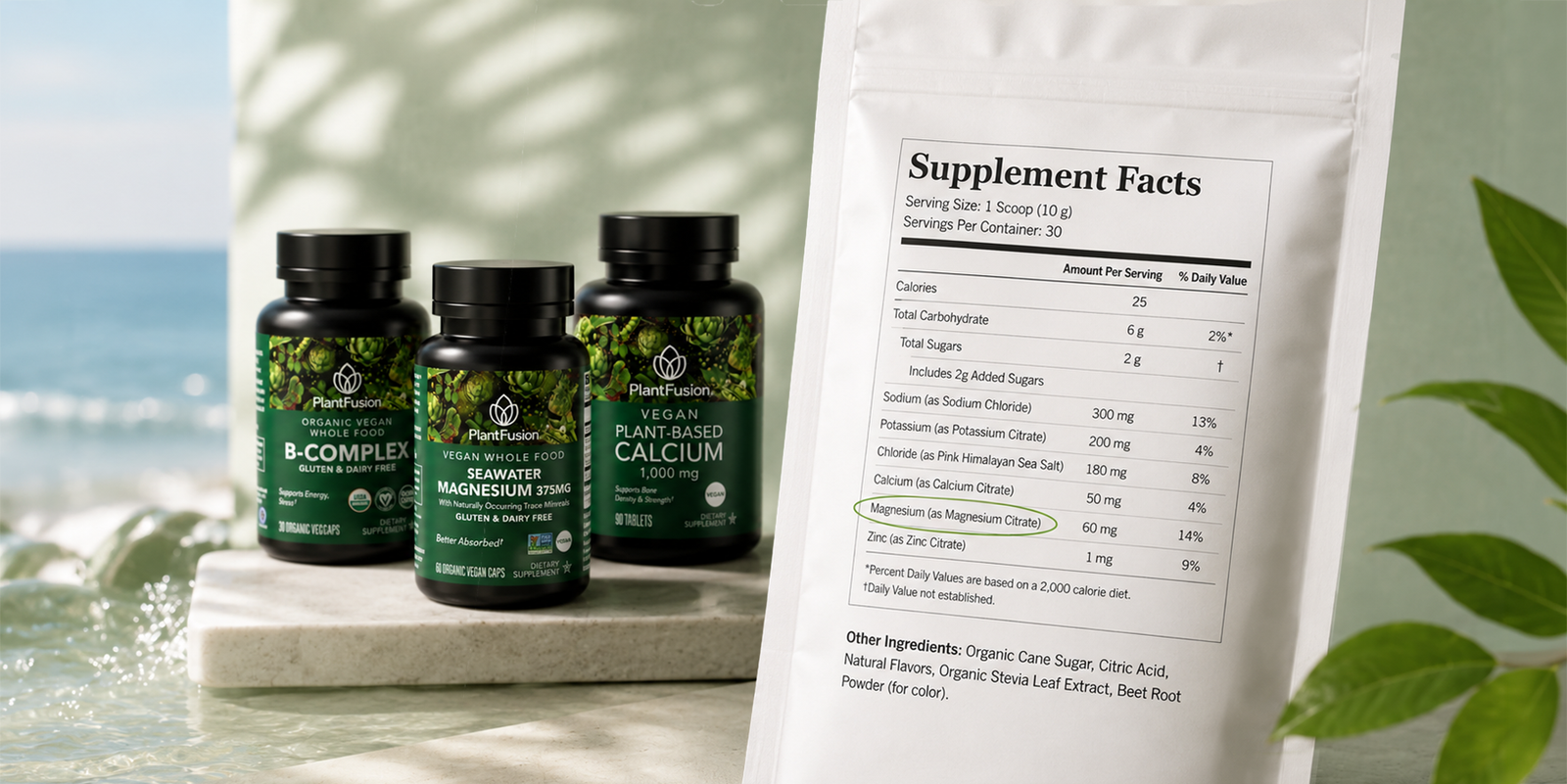
Let’s use magnesium as an example of the importance of nutrient “form”. Studies comparing four different magnesium preparations have shown that magnesium oxide had only 4% absorption rate when compared to three other forms of magnesium - chloride, lactate, and aspartate (Firoz & Graber, 2001). Not very much! The conclusion here……the chemical form matters more than simply the amount of “elemental magnesium” printed on a label.
Organic Vitamins Are About Sourcing. Absorption Is About Form.
Labels such as “organic” or “plant-based” are good clues that higher quality ingredient standards are being used. But, as we saw in the example above, it’s the form of nutrient indicated on the label that determines the potential for absorption. Here is a quick guide for magnesium and two other very popular vitamins:
Choosing a Vegan Magnesium: The absorption rates of typical "magnesium oxide" versions of this nutrient are often single digits (1-9%). Magnesium glycinate, however, is a compound of magnesium with the amino acid glycine. Studies have shown that your body digests it in a similar way that it absorbs microscopic bits of protein (Schuette et al., 1994). For this reason, it’s generally looked upon as favorable when compared to other forms of supplemental magnesium.
Choosing a Vegan Vitamin B12: The word "cyanocobalamin" is typically found in the supplement facts panel of the majority of B12 supplements. Cyanocobalamin is synthetically mass-produced in a laboratory and stable enough to be stored for months, which is why it is the most widely used form of vitamin B12. The issue is that your body must convert this type of B12 before it can be used. Methylcobalamin, the alternative form of vitamin B12, is already one of the active forms. A review of different forms of vitamin B12 conducted in 2017 found that this methyl form is preferred over cyanocobalamin (Paul & Brady, 2017). Since B12 is found almost exclusively in animal foods, getting a good quality form of the vitamin matters even more for those people following a plant-based diet.
Choosing Vegan Vitamin D: The typical plant-based vitamin D supplement contains the D2 form. The D3 version is better in increasing blood levels of vitamin D, according to a meta-analysis of randomized studies (Tripkovic et al., 2012). Nowadays, D3 may be produced naturally from algae, making a vegan-friendly solution possible. Additionally, timing is important. Taking D3 with a fat-containing meal increased peak blood levels by about 32% compared to a fat-free meal (Dawson-Hughes et al., 2015).
Form Meets Function With PlantFusion Plant-Based Vitamins
At PlantFusion®, we build our vitamins around a few core principles………we only utilize plant-based sources, forms of the nutrients your body recognizes, and nothing extra that doesn't need to be there.
Vegan Methyl B-12 provides a cherry-flavored lozenge that dissolves under your tongue and contains 1,000 micrograms of methylcobalamin. It is a straightforward vegan B12 vitamin that promotes healthy nervous system function and energy metabolism.
Vegan Magnesium Glycinate Complex provides 400 mg of magnesium centered around the glycinate form, with citrate and oxide rounding out the blend. This vegan magnesium glycinate supports muscle relaxation and restful sleep.†
Organic Vegan Vitamin D3 + K2 pairs 5,000 IU of algae-sourced D3 with 50 mcg of vitamin K2 (as MK-7) to support healthy bones and calcium use.† It's USDA Certified Organic, making it a vegan D3 supplement that fits a fully plant-based routine. Take it with a meal that includes some fat, like avocado toast or a handful of nuts.
A Better Question to Ask at the Supplement Shelf
The next time you compare bottles, look past the numbers on the label and make sure you’re getting a quality form that’s going to give you the results that you deserve. Methylcobalamin, magnesium glycinate, and vitamin D3 taken with a meal are small details on a label, but they shape what your body actually receives.
Here's your chance to try them and see. All PlantFusion vitamin and mineral supplements are on sale [SALE DETAILS: % off, end date, code if any].
Find the forms your body can use: shop the vitamin and mineral sale →
†These statements have not been evaluated by the Food and Drug Administration. This product is not intended to diagnose, treat, cure, or prevent any disease.